
Seminary Classes in Chapel Hill
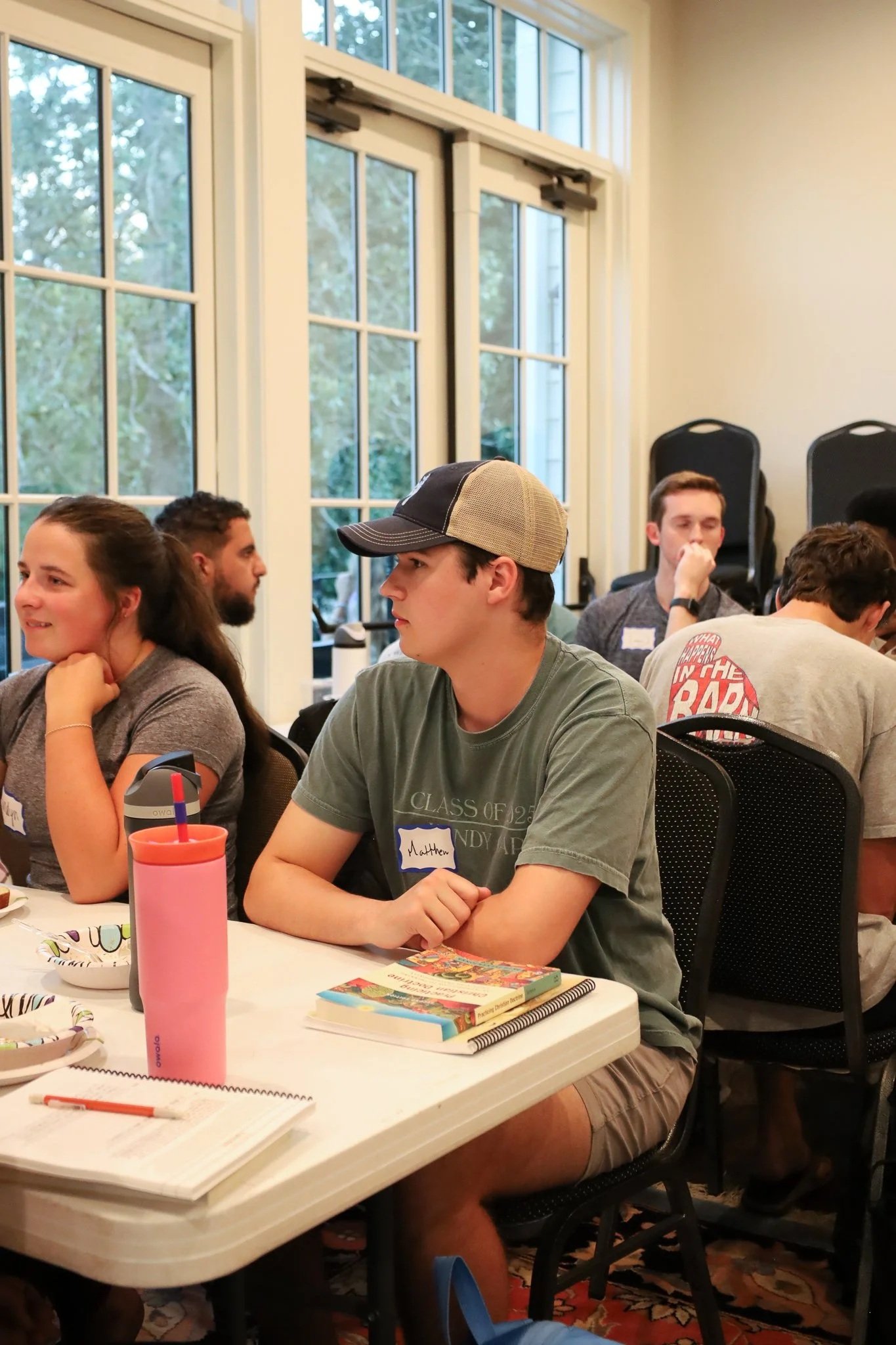
The Study Center offers UNC students the opportunity to take master’s level seminary classes in partnership with Trinity Anglican Seminary. These credit-bearing courses provide robust theological training and spiritual formation, building on students’ experiences in the NCSC Fellows Program. Through completing additional readings and assignments, and by participating in interactive discussions, students will dive deeper into theological study alongside an intimate cohort of peers. Whether you’re interested in exploring seminary coursework, or simply want to strengthen your theological knowledge, taking credit courses through the Study Center will equip you for your future.
Currently, we offer a course on Scripture (corresponding with Fellows Year 1) and a course on theology (corresponding with Fellows Year 2). Each is designed to build on its respective Fellows curriculum, offering more time for substantive dialogue as well as introducing new content.
About Trinity Anglican Seminary
Trinity Anglican Seminary is an evangelical seminary founded in the Anglican tradition, committed to forming men and women for faithful gospel ministry. While their theological roots are Anglican, they have active partnerships with other denominations such as the Evangelical Presbyterian Church and the North American Lutheran Church, and many students who study there come from non-denominational backgrounds.
How These Courses Fit Into Trinity’s Programs
The courses offered by the Study Center will count as electives at Trinity Anglican Seminary. Students who complete them can apply their credits toward the following degrees and diplomas:
Master of Arts in Religion (MAR)
Master of Divinity (MDiv)
Diploma in Christian Ministry
Diploma in Biblical Studies
Diploma in Theology
These credits may also transfer to other graduate schools and seminaries, but the specifics will depend on the target school’s requirements.
2026-27 Course Offerings
BI525: The Grand Story of Scripture
This class provides an introduction to the Old and New Testaments, tracing the story arc of the Bible from Genesis to Revelation. It explores in depth the diverse books, genres, and themes of the Bible while showing how they comprise a unified whole. Attention is given to the historical and cultural contexts of Scripture, the development of core theological themes, and the ways in which the Old and New Testaments mutually illuminate one another. Students will learn to read biblical texts with greater literary sensitivity and theological insight, gaining tools for faithful interpretation and application. By the end of the course, participants will have a clearer grasp of the Bible’s central message and a deeper confidence in interpreting Scripture well.
Tuesdays, 5:00-6:45 pm (Fellows weeks)
Tuesdays, 4:00-5:15 pm (Off-weeks)
ST675: Introduction to Thinking and Living Theologically
In this course, students will engage the central doctrines of the Christian faith—such as the Trinity, creation, sin, salvation, the Church, and last things—while attending to how these doctrines have been articulated throughout Church history. Drawing from Scripture, the Church Fathers, and classic theological texts, we will consider not only what Christians believe, but how Christians are called to live. Theology entails more than mere factual knowledge (knowing the right things); it is also about wisdom and virtue (living in certain ways). True theology forms us into the image of Jesus Christ.
Tuesdays, 7:00-8:45 pm (Fellows weeks)
Fridays, 9:30-10:45 am (Off-weeks)
Program Details
Structure & Meeting Times
Each course runs for the full academic year (fall and spring). Dates will be included in the course syllabi. Students are expected to participate in Fellows (or listen to the recording, see FAQ below) and attend cohort meetings on Fellows off-weeks. The cohort meetings will include additional readings for discussion.

Eligibility
To enroll in for-credit courses, students must:
Be in good academic standing with UNC
Be committed to master’s level coursework
Register through the Study Center by Friday, Aug. 28th, 2026
Finalize registration through Trinity by the drop/add deadline (Nov. 15th, 2026)
Non-student community members may also be eligible. Email us if you are interested in taking courses at the Study Center.
Cost
Thanks to the generosity of donors, we are able to offer these courses at a reduced rate of $500. Please note: This fee does not cover course materials.
Registration
Click the link below to register for the 2026-27 academic year. Your tuition payment will not be due until the spring of 2027.
Frequently Asked Questions
-
These are master's level seminary classes that will remain on your academic transcript (through Trinity, not UNC). With that said, each class is typically offered in a single semester, but will be spread out over the entire academic year. This effectively cuts the workload in half and allows students to complete coursework during UNC's winter break, for example.
In a typical introductory graduate-level theology course, the reading load is rigorous but manageable. You can expect to read approximately 50-90 pages for each bi-weekly meeting. This usually includes a combination of primary theological texts (such as Augustine, John Calvin, or Karl Barth) and secondary scholarship that helps frame and interpret the material. In addition to readings, there will be papers and assignments, comparable to upper-level humanities classes at UNC.
If you're concerned about the workload, you have until the drop/add deadline (Nov. 15th) to decide to officially register. This allows you to experience the workload and expectations before committing to credit.
-
Students who register should consider the workload and timing alongside their UNC classes and other commitments. If you have a conflict in either the fall or the spring, unfortunately, you will not be able to register.
-
Yes! Students who have completed Fellows Year 1 or 2 are invited to participate in the complementary for-credit course by listening to recordings of the Fellows sessions and completing the for-credit requirements.
-
No! These courses are taught in an ecumenical fashion similar to Fellows. Students who choose to go on to Trinity for seminary are also welcome, regardless of their denominational background. For courses that are Anglican-specific at Trinity, such as those covering Anglican polity or liturgy, they offer substitute versions so that students can still meet the same learning goals within their own denominational context. In other words, you do not need to be Anglican to study at Trinity after graduating.
-
Potentially, yes! Email us if you are interested in taking seminary courses in Chapel Hill.